A ₹100 Crore Home Is Impressive. But How Many Actually Sold?
A property being priced at ₹100 crore, ₹200 crore or even ₹270 crore can generate headlines. But a headline does not necessarily prove demand.
There is a much more important question for anyone studying the luxury real estate market:
How quickly is the market actually buying these expensive homes?
This is where absorption rate becomes one of the most useful concepts in real estate.
Imagine two projects:
- Project A has homes priced at ₹10 crore. It sells 10 homes in one year.
- Project B has homes priced at ₹50 crore. It sells 10 homes in one year.
On paper, both projects sold the same number of units. But economically, they are not comparable. Project B absorbed ₹500 crore of inventory, while Project A absorbed ₹100 crore.
Now imagine a project selling dozens of ₹50 crore, ₹75 crore or ₹100 crore homes. That tells us something much more interesting than a simple property-price headline. It shows that wealthy buyers are deploying capital at that price level.
That is the real meaning behind absorption in a luxury market.
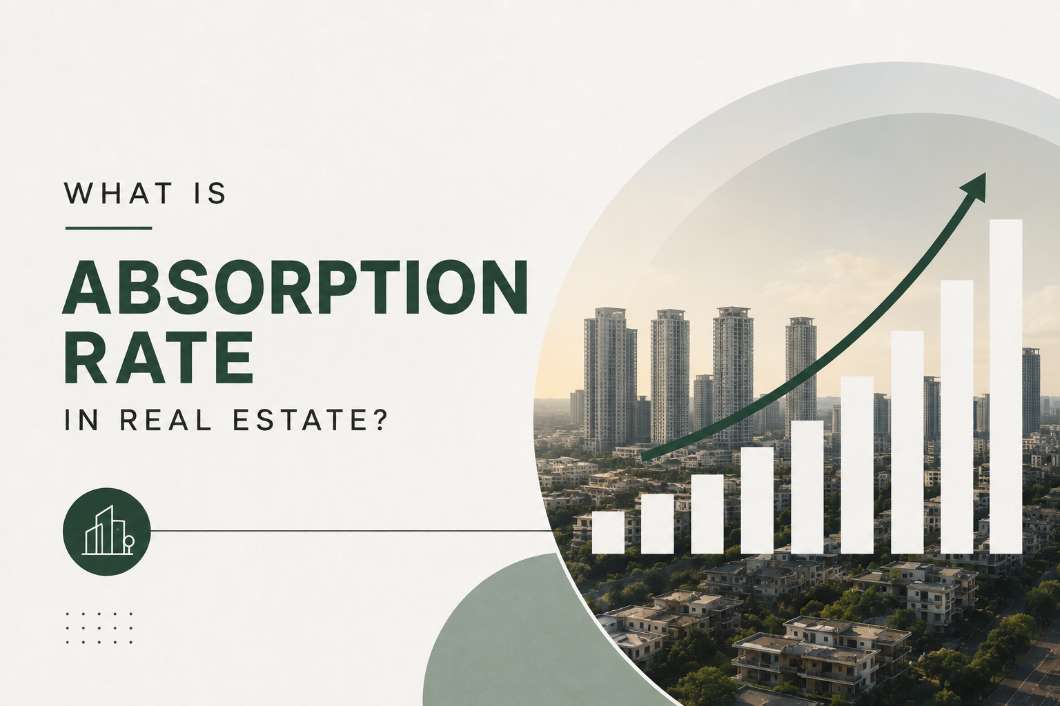
What Is Absorption Rate in Real Estate?
Absorption rate measures how quickly available real estate inventory is sold, or absorbed, by buyers over a specific period.
★ IN SIMPLE LANGUAGE
Absorption tells you how fast the market is eating up available properties.
Suppose a luxury project has 100 available residences and sells 20 residences in 12 months. Its annual absorption rate is approximately 20%.
| Available Inventory | Units Sold (12 Mos) | Annual Absorption Rate |
|---|---|---|
| 100 residences | 20 residences | 20% |
| 100 residences | 50 residences | 50% |
| 100 residences | 80 residences | 80% |
The higher the absorption rate, the stronger the evidence that buyers are taking inventory off the market. But there is an important catch.
High Absorption Alone Does Not Tell the Whole Story
This is where many property reports become misleading. Consider two contrasting developments:
- Project A: Sells 500 apartments at ₹2 crore each → Total value absorbed = ₹1,000 crore
- Project B: Sells 20 apartments at ₹50 crore each → Total value absorbed = ₹1,000 crore
Both projects absorbed ₹1,000 crore of inventory. But the market dynamics are completely different. Project A has a much larger buyer pool. Project B has only a tiny group of buyers who can purchase.
That is why luxury real estate needs to be analyzed using both unit absorption and ticket size. At the ultra-luxury level, a project can sell relatively few homes while still demonstrating exceptionally strong demand.
The Three Numbers You Should Look At
When analyzing a luxury project, donot look only at: "How many homes were sold?" Look at these three numbers together:
- Units Sold: How many residences actually moved?
- Absorption Rate: What percentage of the available inventory has been sold?
- Value Absorbed: How many crores of inventory did buyers actually purchase?
This third number becomes extremely important at the top end of the market. Because selling 100 homes × ₹2 crore = ₹200 crore is very different from selling 10 homes × ₹50 crore = ₹500 crore. The second project has sold fewer homes but absorbed much more capital.
What Does “Ultra-High Ticket Absorption” Mean?
This phrase sounds complicated, but the idea is simple. Ticket size equals the value of one property transaction.
- ₹2 crore: High ticket relative to mainstream housing
- ₹10 crore: Luxury ticket
- ₹25 crore: Ultra-luxury territory
- ₹50 crore+: Ultra-high ticket territory
- ₹100 crore+: Trophy-home territory
When properties at these levels are actually being purchased in meaningful numbers, we can call that absorption at ultra-high ticket sizes.
Why Absorption Is More Powerful Than Hype
Luxury real estate creates a lot of noise. A project can have famous branding, celebrity endorsements, beautiful advertisements, huge social-media reach, luxury brochures, influencer coverage, and massive launch events. All of that can create attention. But attention is not the same as demand.
A project can trend online and still struggle to sell. Absorption tells you something different: People are putting real money behind the story. That distinction is critical.
Hype vs Demand: The Real Difference
Consider two fictional luxury projects:
| Project Alpha (Hype-Driven) | Project Beta (Demand-Driven) |
|---|---|
|
|
| Sales Performance: 8 out of 100 residences sold in six months. | Sales Performance: 60 out of 100 residences sold in six months. |
Which project has stronger market demand? Project Beta. Why? Because the market voted with money.
★ THE CENTRAL IDEA
Marketing creates awareness. Absorption reveals market acceptance.
Why Absorption Matters Even More in Gurgaon
Gurgaon has developed one of Indias strongest luxury residential ecosystems. The city has HNI entrepreneurs, business families, corporate executives, founders, investors, NRIs, and internationally exposed buyers. This creates a large pool of affluent purchasers.
But even in Gurgaon, there is a huge difference between ₹5 crore, ₹50 crore, and ₹100 crore+. As ticket size rises, the available buyer pool shrinks dramatically. That makes absorption at very high prices much more informative.
If a project selling ₹3 crore homes moves quickly, that demonstrates strong premium demand. If another project selling ₹50 crore homes also moves quickly, it shows something deeper: genuine purchasing power at the very top of the Gurgaon market.
The Luxury Market Has Its Own Supply-and-Demand Curve
The property market is not one single market. There are distinct layers:
- Affordable housing: Large buyer pool, high transaction volume, lower ticket size
- Mid-premium housing: Moderate buyer pool, higher ticket size, broader affordability
- Luxury housing: Smaller buyer pool, high ticket size, more selective demand
- Ultra-luxury housing: Very small buyer pool, extremely high ticket size, scarcity becomes critical
- Trophy residences: Tiny buyer pool, exceptional ticket sizes, status, privacy and scarcity dominate
This is why a project selling only a few dozen residences can still be a major market success. Volume is relative to the size of the buyer universe.
Absorption Rate and Sales Velocity Are Related—but Different
People often use the terms interchangeably. They shouldnt.
- Absorption Rate: Tells you what percentage of inventory has been sold.
- Sales Velocity: Tells you how quickly those sales are happening.
For example, if Project A (100 units) sells 25 units in 12 months, and Project B (100 units) sells 25 units in 2 months, both have technically achieved 25% absorption. But Project B has much stronger sales velocity.
That is why smart market analysis asks: How much was sold, how quickly, and at what price?
The “Speed × Price” Test & Pricing Power
Here is a much more useful framework for luxury real estate. A project becomes especially interesting when it combines: High price + high sales velocity. That combination is difficult to achieve.
If a project is expensive but sells slowly, buyers may be resisting the price. If it sells quickly but is relatively inexpensive, the story may simply be broad affordability. But when buyers rapidly absorb expensive inventory, the market is demonstrating pricing power.
Pricing power means a seller can maintain a premium price because buyers are willing to transact at that level. Suppose a project is priced at ₹30 crore and buyers keep purchasing. The developer doesnot need to offer massive discounts, and inventory continues moving. That suggests the market accepts the price.
Now imagine a project priced at ₹30 crores, but almost every serious buyer demands ₹24 crore. That tells you the headline price may not reflect the markets true willingness to pay. Therefore: Absorption can help reveal whether a price is real or merely aspirational.
Why ₹100 Crore Sales Change the Conversation
A ₹100 crore residential transaction is interesting not simply because it is expensive. It matters because relatively few people can make that purchase. When several ultra-high-value residences transact, the market is revealing something about Indias wealth concentration.
The question becomes: How deep is Indias pool of buyers willing to allocate ₹50 crore, ₹100 crore or more toward residential real estate? That is a far more sophisticated question than: “What is the most expensive apartment in Gurgaon?”
The first question measures market depth. The second measures headline value.
The Dahlias Example: Why the Market Watches It
Projects such as DLF The Dahlias have attracted enormous attention because of the size of individual transactions and the overall value of inventory being absorbed. A reported transaction of roughly ₹271 crore is fascinating.
But the real market story becomes much stronger when you consider that kind of headline alongside the developments broader sales performance. One extremely expensive residence can be an outlier. Multiple high-value transactions indicate something different: A repeatable buyer segment.
That is what serious market observers watch. The question is not: “Did someone once pay ₹271 crore?” The question is: “Are multiple wealthy buyers consistently willing to pay extraordinary prices for extraordinary residences?” That is where absorption becomes powerful.
Why Developers & Investors Care About Absorption
Both developers and investors rely heavily on absorption metrics to make strategic, capital-intensive decisions.
Why Developers Care:
- To understand how quickly inventory is moving and whether pricing is accepted.
- To determine how much new inventory the market can handle.
- To evaluate if the launch strategy is working and how quickly capital is being recycled.
- Strong absorption encourages launching new phases; weak absorption signals a need to reassess product, pricing, or location.
Why Investors Care:
For investors, absorption helps reveal a micro-markets health. It answers critical questions:
- Is there real end-user demand?
- Is the market accepting current prices?
- Is supply being created faster than buyers can absorb it?
- Is a project genuinely scarce?
- Is the developer successfully positioning the product?
Beware: Absorption Can Be Misleading
This is the part most promotional articles do not discuss. Not every “booking” means the same thing. A serious analysis should distinguish between:
Expression of Interest → Token amount → Booking → Agreement → Registration → Completed transaction
Similarly, developers may define inventory launched, inventory available, units sold, gross bookings, and net bookings differently. Smart analysis always asks: Sold compared with what? Saying "50 homes sold" is meaningless without knowing whether it was 50 out of 60 or 50 out of 500.
Gross Value Absorption Metric
Suppose Project A sells 50 homes at ₹20 crore each (Gross value absorbed = ₹1,000 crore). Another project, Project B, sells 10 homes at ₹50 crore each (Gross value absorbed = ₹500 crore). Comparing only unit volume makes Project A look dramatically stronger, but looking at capital absorbed reveals high buyer concentration and purchasing power in Project B.
Sophisticated luxury-market analysis should include: Units absorbed, Percentage absorbed, Average ticket size, Total booking value, and Time taken.
A Better Way to Analyze Any Luxury Project & The Formulas
Before believing that a luxury project is “selling fast,” ask five questions:
- How much inventory was available?
- How many units were sold?
- Over what period?
- At what average ticket size?
- How much total value was absorbed?
The Golden Formulas
1. Standard Absorption Rate Formula
Absorption Rate (%) = (Units Sold ÷ Available Inventory) × 100
Example: 100 sold ÷ 500 available × 100 = 20% Absorption
2. Capital Absorption Formula (Luxury Layer)
Capital Absorption = Units Sold × Average Transaction Value
Example: 100 units × ₹20 crore = ₹2,000 Crore Absorbed
The 10x Insight: Donot Ask “How Expensive Is It?”
This is the mistake most property buyers make. They see ₹30,000/sq ft, ₹50,000/sq ft, or ₹1 lakh/sq ft and immediately ask: “Isnt that too expensive?”
Thats not the best question. A better question is: “Are buyers actually accepting that price?”
Because a high price with weak absorption may indicate overpricing. A high price with strong absorption may indicate genuine scarcity and pricing power. That single shift in thinking can dramatically improve how someone evaluates luxury property.
Something can be expensive without being valuable. And something can be expensive because it is genuinely scarce. The job of market analysis is to determine which one you are looking at.
Absorption does not prove that a property is automatically a good investment. But it provides a critical piece of evidence: The market is—or is not—accepting the product at the stated price. That is powerful information.
What Absorption Tells Us About Gurgaons Ultra-Luxury Market
When extremely expensive residences keep finding buyers, the implication goes beyond individual projects. It suggests that Gurgaon has developed a sufficiently deep pool of affluent buyers to support a genuine ultra-luxury segment.
That does not mean every ₹50 crore or ₹100 crore property will succeed. It means something more nuanced: Exceptional properties can command exceptional prices when the right buyer, location, product and scarcity come together. That is the real story behind Gurgaons ultra-luxury market.
Final Takeaway
The next time you read: “₹100 crore apartment sold in Gurgaon,” donot stop at the headline. Ask:
- How many sold?
- How quickly?
- What percentage of inventory moved?
- What was the average ticket size?
- How much total capital was absorbed?
Because one expensive transaction can create a headline. But repeated high-value transactions create market evidence.
★ SUMMARY CONCLUSION
And when a luxury development consistently sells a meaningful percentage of its inventory at extremely high ticket sizes, something important is happening:
The market is not merely admiring the property. The market is buying it.
That is absorption. And in luxury real estate, real absorption is one of the clearest signals that demand is strong enough to support the price.
Frequently Asked Questions (FAQs)
Q: What is absorption rate in real estate?
Absorption rate measures how quickly available real estate inventory is sold within a defined period. It helps investors gauge buyer demand relative to supply. A higher absorption rate generally means inventory is moving faster, while a lower rate can indicate weaker demand, excess supply, or pricing resistance.
Q: How do you calculate real estate absorption rate?
The standard formula is: Absorption Rate = Units Sold ÷ Available Inventory × 100. For example, if a project has 200 available homes and sells 50 during a year, its annual absorption rate is 25%. The calculation should always specify the inventory base and time period being analyzed.
Q: What is a good absorption rate for luxury real estate?
There is no universal “good” absorption rate because luxury projects have smaller buyer pools and higher prices than mainstream housing. A strong rate depends on location, project stage, inventory released, ticket size, and market conditions. Comparing similar projects within the same luxury segment provides a more meaningful benchmark.
Q: Why does absorption matter for luxury property buyers?
Absorption helps buyers understand whether the market is actually accepting a projects pricing and positioning. Strong absorption can indicate genuine demand, while slow absorption may signal pricing pressure or excess inventory. However, buyers should also evaluate approvals, construction quality, developer credibility, location, resale liquidity, and the projects long-term fundamentals.
Q: What is the difference between absorption rate and sales velocity?
Absorption rate measures the percentage of available inventory sold, while sales velocity measures how quickly those sales occurred. Two projects can have the same absorption rate but very different sales velocities. A project selling 30% of inventory in three months has much faster velocity than one taking two years.
Q: What does high absorption at a high ticket size mean?
High absorption at a high ticket size means buyers are purchasing a meaningful amount of expensive inventory rather than merely showing interest. It can indicate strong purchasing power and pricing acceptance among affluent buyers. In ultra-luxury markets, this can be a stronger demand signal than large sales volumes at lower prices.
Q: Can high absorption mean a property is overpriced?
Not necessarily. High absorption generally indicates that buyers are accepting the product and its pricing, but it does not prove the property is fairly valued. Buyers should compare transaction prices, competing supply, future inventory, location quality, rental depth and resale demand before concluding that a property is attractively priced.
Q: Is absorption rate useful for comparing Gurgaon luxury projects?
Yes, but compare carefully. Gurgaon luxury projects vary significantly in unit sizes, ticket prices, launch phases and buyer profiles. Absorption becomes more meaningful when you compare projects using similar metrics such as percentage inventory sold, average ticket size, sales velocity, and total value absorbed.
Q: Why is ticket size important when analyzing absorption?
Ticket size shows how much capital each buyer is committing. Selling 100 homes at ₹5 crore and selling 20 homes at ₹25 crore both represent ₹500 crore of sales value. In luxury markets, a smaller number of transactions can therefore represent substantial capital absorption and strong demand from a much narrower buyer pool.
Q: Does strong absorption guarantee property appreciation?
No. Strong absorption indicates current demand but does not guarantee future appreciation. Future supply, economic conditions, interest rates, infrastructure, project execution, maintenance costs, and resale liquidity can affect property values. Treat absorption as one market indicator within a broader property investment analysis.