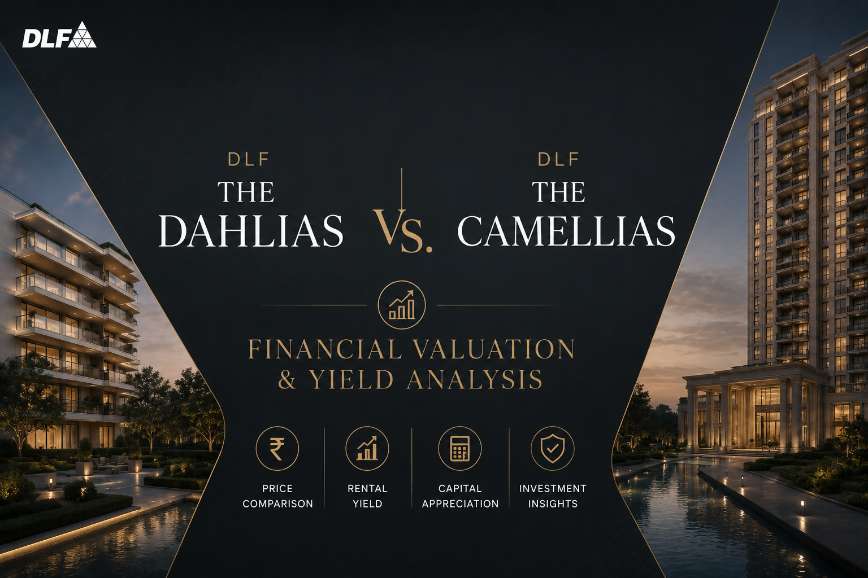
DLF The Dahlias vs. The Camellias Financial Valuation & Yield Analysis
Which Luxury Property Is the Better Investment in 2026?
DLF The Dahlias vs. The Camellias is no longer simply a comparison between two luxury residences. For an investor, the more important question is whether you are buying cash flow, capital appreciation, scarcity, brand value, or long-term wealth preservation.
Both projects sit at the top end of Gurugrams luxury residential market, but their investment profiles differ significantly. The Camellias is a completed, proven asset with an established resale and rental market. The Dahlias is the newer ultra-luxury proposition, offering larger residences and a fresh product but carrying construction, pricing, and future-liquidity considerations.
For high-net-worth investors, this distinction matters more than the headline price.
DLF The Dahlias vs. The Camellias: Investment Snapshot
| Parameter | DLF The Camellias | DLF The Dahlias |
|---|---|---|
| Location | Sector 42, Golf Course Road | Sector 54, Golf Course Road |
| Status | Ready / completed | Under development |
| Typical apartment size | 7,350 sq. ft. and above | 9,500 sq. ft. and above |
| Indicative market value | ₹65-100+ crore | ₹62-135+ crore depending on configuration and pricing |
| Current market positioning | Established ultra-luxury benchmark | New-generation ultra-luxury benchmark |
| Rental market | Established | Limited / not yet mature |
| Indicative monthly rent | ₹10.5-14 lakh | Future rent is difficult to establish reliably |
| Gross rental yield | Approximately 1.8-2.5% in many scenarios | Potentially around 1.5-2.5% once operational, depending on final value and rent |
| Capital appreciation thesis | Proven | Higher potential but less proven |
| Liquidity | Relatively stronger | Future liquidity |
| Construction risk | Low | Higher |
| Investment profile | Wealth preservation + resale | Long-term appreciation + trophy ownership |
The figures above are indicative market ranges, not guaranteed transaction prices. Ultra-luxury property pricing varies dramatically by tower, floor, view, configuration, interiors, payment structure and seller urgency. Current reported pricing for The Camellias is broadly around ₹65,000-₹85,000 per sq. ft. in recent market reporting, while The Dahlias has been reported across a wide range depending on unit and stage.
The First Principle: These Are Not Yield Properties
The biggest mistake an investor can make is evaluating The Dahlias or The Camellias like a conventional rental apartment.
A ₹70 crore property generating ₹12 lakh per month sounds impressive because ₹12 lakhs is an enormous monthly rent. But the annual rent is:
Gross Yield Calculation:
₹12 lakh × 12 = ₹1.44 crore
Against a ₹70 crore asset, the gross rental yield is only:
₹1.44 crore ÷ ₹70 crore × 100 = 2.06%
After maintenance, vacancy, brokerage, property taxes, furnishing expenses and other ownership costs, the effective yield is lower. This is why DLF The Camellias rental yield and DLF The Dahlias rental yield should never be viewed in isolation.
These are primarily capital-appreciation and wealth-preservation assets, with rental income as a secondary return.
Golf Course Road itself has a relatively low yield profile because property values have risen much faster than rents. Market estimates commonly put gross luxury residential yields in the area around the 2.5-3.5% range overall, with ultra-luxury assets often below that because of their exceptionally high capital values.
DLF The Camellias: Financial Valuation
The Camellias has something The Dahlias cannot yet provide: a proven market track record.
The project was launched at approximately ₹22,000 per sq. ft., while recent market reporting has placed resale and base selling values substantially higher. Some large transactions have crossed ₹90 crores, while an 11,000 sq. ft. resale transaction was reported at ₹114 crores. That historical performance matters because it gives investors something close to a real valuation benchmark.
Current Camellias Valuation Scenario
Consider a hypothetical 7,400 sq. ft. residence:
- At ₹70,000 per sq. ft., the approximate property value is 7,400 × ₹70,000 = ₹51.8 crore.
- At ₹85,000 per sq. ft., the valuation becomes approximately ₹62.9 crore.
However, premium floors, views, interiors, larger configurations and particularly strong resale positioning can push actual transaction values substantially higher. This is why quoting one DLF The Camellias price can be misleading.
A better approach is to determine the value based on: Configuration + floor + view + condition + transaction comparables + ownership structure.
DLF The Camellias Rental Yield
The Camellias has one major advantage over The Dahlias: the rental market already exists.
Recent listings and market reports indicate rents around ₹10.5 lakh per month for unfurnished residences and about ₹14 lakhs for furnished residences, with individual listings varying by size, furnishings, and terms.
Example: ₹14 lakhs monthly rent (Annual rent: ₹14 lakh × 12 = ₹1.68 crore)
- At ₹70 crore valuation: Gross yield = 1.68 ÷ 70 × 100 = 2.40%
- At ₹80 crore valuation: Gross yield = 1.68 ÷ 80 × 100 = 2.10%
- At ₹90 crore valuation: Gross yield = 1.68 ÷ 90 × 100 = 1.87%
The lesson is simple: As the capital value rises, rental yield compresses. That is exactly what has happened across many ultra-luxury residential markets.
Why Investors Still Buy the Camellias Despite Low Yield
Because the objective is not necessarily rental income. A buyer investing ₹70–90 crore in The Camellias may be more interested in:
- Capital preservation
- Golf Course Road scarcity
- DLF brand value
- Established community
- International-standard amenities
- Resale credibility
- High-net-worth tenant demand
- Long-term asset quality
The Camellias has already established a reputation as one of Gurugrams most important luxury residential addresses. Current market reporting describes it as a benchmark project for the citys ultra-luxury segment. That maturity has financial value.
DLF The Dahlias: Financial Valuation
The Dahlias represents a different investment proposition. Instead of buying an established luxury asset, the buyer is purchasing a new ultra-luxury product at the beginning of its market lifecycle.
Reported pricing varies considerably across sources and configurations. Current indicative figures show entry values around ₹61–65 crore for certain configurations, while other market reports place higher-ticket units substantially above ₹100 crores. Reported asking prices have also moved sharply as inventory and launch-stage pricing evolved.
This creates an important investment question: Is The Dahlias expensive? Yes. Is it necessarily overvalued? Not automatically. That depends on what price the market ultimately assigns to the completed asset.
The Dahlias Appreciation Equation
Suppose an investor acquires a residence for ₹70 crores and assumes its value appreciates over 5 years:
- At 8% CAGR: ₹70 crores × (1.08)^5 ≈ ₹102.8 crore
- At 10% CAGR: ₹70 crores × (1.10)^5 ≈ ₹112.7 crore
- At 12% CAGR: ₹70 crores × (1.12)^5 ≈ ₹123.4 crore
This illustrates why affluent investors may tolerate a very low rental yield. The rental income may be only 1.5-2.5% of the property value, while the investors actual objective is potentially much larger capital appreciation. However, projected appreciation is not guaranteed. The Dahlias has a much shorter transaction history, so its long-term price discovery remains less certain than The Camellias.
DLF The Dahlias Rental Yield
This is where the comparison becomes interesting. The Dahlias does not yet have the same mature rental market as The Camellias. Available rental data is limited, and the project is still in development, so todays rent cannot be confidently used as a long-term investment metric.
Some market estimates suggest that once completed, comparable ultra-luxury residences could potentially command rents in the ₹15-25 lakh per month range.
Rental Yield Modeling on ₹100 Cr Property:
Annual Rental Income = ₹20 lakh × 12 = ₹2.4 crore
On a ₹100 crore property:
Gross Yield = 2.4 ÷ 100 × 100 = 2.4% gross yield
Again, impressive rent, but unimpressive yield. That is the defining characteristic of ultra-luxury real estate.
Camellias vs. Dahlias: Comparative Financial Metrics
1. Gross Rental Yield Direct Comparison
- Camellias (Assumed value: ₹70 crores | Annual rent: ₹1.68 crore) -> Gross yield: 2.40%
- Dahlias (Assumed completed value: ₹100 crores | Annual rent: ₹2.40 crore) -> Gross yield: 2.40%
The conclusion is surprising: The property generating more rent does not necessarily generate a higher yield. Yield depends on both rent and asset value. That means investors should compare Rent ÷ Purchase Price rather than simply asking, How much rent can I get?
2. Capital Appreciation
This is where The Camellias currently has the advantage in terms of evidence. The project already has a substantial historical transaction record, moving from ₹22,000/sq. ft. at launch to much higher resale levels. That doesnt mean Camellias will necessarily outperform The Dahlias from today; it means Camellias has demonstrated price discovery, while The Dahlias still needs to establish it.
- The Camellias strategy: Buy a proven asset where much of the market validation has already occurred.
- The Dahlias strategy: Buy into a new benchmark and bet that scarcity, specifications, DLF positioning and future luxury demand will support further appreciation.
3. Scarcity & Benchmark Competition
The Dahlias is not competing with conventional Gurgaon apartments. Its competition is the small number of properties that can credibly be described as trophy residential assets. A wealthy buyer considering a ₹100 crore residence compares it with a rare Mumbai luxury residence, a global trophy property, or a large independent luxury home.
4. Liquidity & Construction Risk
- Liquidity Metric: The Camellias is completed, fully inspectable, with demonstrated rental income and active resale transactions. The Dahlias future resale liquidity is an investment variable, not yet an established fact.
- Construction Risk: Camellias carries near-zero construction risk. Dahlias buyers carry construction execution risk, possession timing risk, and market-cycle risk during development. In investment terminology, Dahlias is a higher-duration, higher-uncertainty bet.
5. Net Rental Yield Mechanics
Gross yield is not the return that ultimately matters. After deducting maintenance, property management, repairs, vacancy, brokerage, furnishing replacement, and taxes, effective net income falls materially below headline rent. Investors must always compute Net Rental Yield = Net Annual Rental Income ÷ Total Acquisition Cost × 100.
Five-Year Investment Modeling Scenarios
Scenario A: The Camellias
- Purchase value: ₹75 crore
- Assumed appreciation (8% CAGR): Five-year value ≈ ₹110.2 crore
- Assumed average gross rent: ₹1.5 crore per year (5-year total = ₹7.5 crore)
- Combined potential value before costs: ₹117.7 crore
Scenario B: The Dahlias
- Purchase value: ₹90 crore
- Assumed appreciation (10% CAGR): Five-year value ≈ ₹144.9 crore
- Assumed average annual rental income after completion: ₹2 crores (5-year total = ₹10 crore)
- Combined potential value before costs: ₹154.9 crore
The point of this modelling exercise is to demonstrate the difference in investment thesis: The Dahlias needs stronger future appreciation to justify its development-stage and pricing risk.
Key Takeaway on ROI vs Yield:
Total Return = Capital Appreciation + Net Rental Income – Acquisition Costs – Holding Costs – Selling Costs
A property with 2% rental yield + 10% appreciation dramatically outperforms a property with 4% rental yield + 3% appreciation.
DLF The Dahlias vs. The Camellias: Risk-Adjusted Matrix
| Evaluation Factor | Winner / Leading Asset |
|---|---|
| Proven market value | The Camellias |
| Immediate rental income | The Camellias |
| Construction certainty | The Camellias |
| Resale-market evidence | The Camellias |
| Newness & Modern Specifications | The Dahlias |
| Large-format living | The Dahlias |
| Future product differentiation | The Dahlias |
| Established tenant market | The Camellias |
| Long-term trophy positioning | The Dahlias |
| Investment visibility today | The Camellias |
| Future upside potential | The Dahlias |
| Risk-adjusted certainty | The Camellias |
Investor Profiles: Who Should Buy Which Asset?
Who Should Buy the Camellias?
The Camellias are arguably better suited to an investor who values: Established asset quality, immediate possession, existing rental income, proven resale demand, lower construction risk, an established luxury ecosystem, and immediate capital preservation.
Who Should Buy the Dahlias?
The Dahlias may suit an investor who wants: Next-generation ultra-luxury, larger residences, long holding periods, higher future scarcity value, potential capital appreciation, trophy-property positioning, and a newer DLF flagship asset.
DLF The Dahlias vs. The Camellias: Final Investment Verdict
For income-oriented investors, neither project is particularly attractive compared with lower-priced residential assets because rental yields are compressed by extremely high capital values.
For capital preservation, The Camellias has a stronger argument because of its completed status, established market and demonstrated transaction history.
For future appreciation, The Dahlias may offer a more interesting opportunity because it represents a newer ultra-luxury benchmark. But that potential comes with greater uncertainty because future resale liquidity and completed-market valuation are not yet fully established.
Our Strategic Investment View:
The Camellias is the stronger proven asset. The Dahlias is the stronger future-value bet.
- For an investor with a 5-10 year horizon, substantial liquidity and a tolerance for development-stage risk, The Dahlias makes strategic sense.
- For an investor seeking wealth preservation with an immediately understandable exit market, The Camellias remains the more defensible financial choice.
Final Thoughts:
DLF The Camellias vs. The Dahlias is not simply a ₹70 crore versus ₹100 crore decision. It is a decision between:
- Proven value vs. future value
- Immediate liquidity vs. future liquidity
- Lower development risk vs. higher potential upside
- Established rental market vs. future rental market
- Wealth preservation vs. trophy-asset positioning
For investors who want a proven ultra-luxury asset in Gurgaon, The Camellias remains one of the strongest choices. For investors willing to take a longer-term view on Gurgaons next generation of trophy residences, The Dahlias offers a compelling but more speculative proposition.
At this level of real estate, the best investment is rarely the property with the highest rent. It is the property where the relationship between acquisition price, scarcity, appreciation potential, liquidity and risk is most attractive. Thats the real financial difference between DLF The Dahlias and The Camellias.
Frequently Asked Questions
1. Is DLF The Dahlias a better investment than The Camellias?
DLF The Dahlias may offer stronger long-term appreciation potential because it is a newer ultra-luxury development, but it also carries higher development and resale uncertainty. The Camellias has a proven market, established rental demand, and documented resale transactions. Investors seeking certainty may prefer Camellias, while long-term risk-takers may prefer Dahlias.
2. What is the rental yield of DLF The Camellias?
DLF The Camellias generally offers a low gross rental yield compared with conventional residential investments because capital values are extremely high. With rents commonly reported around ₹10.5-14 lakh monthly, gross yield typically falls around 2%, depending on purchase price, configuration, and furnishing. Net yield is lower after expenses.
3. What rental yield can investors expect from DLF The Dahlias?
The Dahlias does not yet have a mature rental market, so its eventual yield cannot be established with confidence. Future rents may potentially be substantial because of the projects size and positioning, but high capital values are likely to keep rental yields relatively modest. The investment case therefore depends more on appreciation than income.
4. Which has better resale liquidity, The Dahlias or The Camellias?
The Camellias currently has better resale visibility because it is completed and has an established secondary market. Buyers can assess completed residences, rental income, transaction history, and actual market demand. The Dahlias is newer, and its future liquidity will depend on completion, resale demand, pricing, and how successfully the project establishes itself.
5. Is DLF The Dahlias overpriced?
Calling The Dahlias overpriced solely from its headline ticket size can be misleading. Ultra-luxury valuation depends on scarcity, apartment size, location, amenities, brand positioning, floor, views, and future demand. However, the premium means investors must achieve sufficient capital appreciation to justify the higher entry valuation and development-stage risk.
6. Which property is better for rental income in Gurgaon?
Neither The Dahlias nor The Camellias should be considered high-yield rental investments. Their extremely high capital values compress rental yields despite very high monthly rents. Investors focused mainly on rental income may find better percentage returns in lower-priced Gurgaon segments. These projects suit capital appreciation, lifestyle, and wealth preservation.
7. Which is better for a 10-year investment?
A ten-year investor can consider both, but the appropriate choice depends on risk tolerance. The Camellias offer greater historical validation and established liquidity, while The Dahlias provide exposure to a newer luxury cycle. A long holding period can reduce short-term volatility, but it does not eliminate execution, valuation, or market-cycle risks.
8. What should investors compare before buying The Camellias or The Dahlias?
Investors should compare the exact units purchase price, price per square foot, floor, view, configuration, maintenance, rental potential, payment schedule, acquisition costs, resale liquidity, and expected holding period. At this price level, a project-level comparison is insufficient. The exact apartment can materially change the investment outcome.