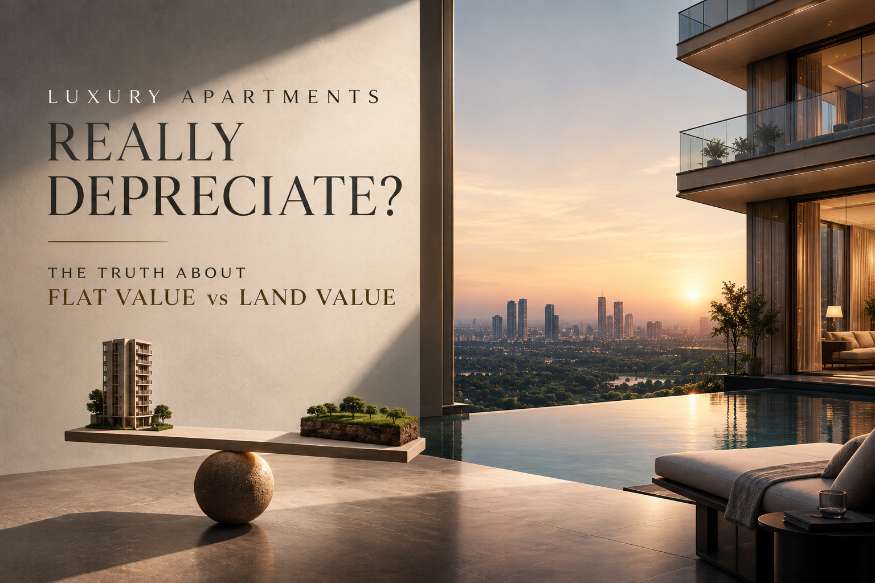
Do Luxury Apartments Really Depreciate? The Truth About Flat Value vs Land Value
The Answer in One Sentence
A luxury apartment is not automatically a depreciating asset. The building can age and physically depreciate, while the land beneath it, the location, scarcity, brand, design quality, services, and demand can increase the market value of the overall property.
The phrase flats depreciate, land appreciates sounds financially clean, but real estate is rarely that simple. A buyer does not purchase a concrete structure in isolation. They purchase a bundle of rights and economic advantages: a share in land, a dwelling, access, location, amenities, title, views, services and the ability to sell that bundle to another buyer later.
For ordinary apartments, a buildings age can drag on resale value. For exceptional luxury properties, however, another force can become stronger: scarcity. Only a limited number of apartments may have a particular address, floor, view, layout, brand, service standard, or relationship to a prime district. When demand for that scarce combination rises faster than supply, the market price can rise even as the physical building ages.
What Actually Depreciates in an Apartment?
The first mistake is treating the flat as one indivisible thing. From an economic perspective, several components move differently over time.
The building structure
The physical structure ages. Finishes need replacement, systems require maintenance, and buyers may eventually discount older construction.
The land component
Land does not wear out in the same physical way. Its value depends on location, scarcity, infrastructure, zoning, connectivity, and demand.
The location premium
A prime address can become more desirable as employment, infrastructure, social infrastructure and prestige concentrate around it.
The scarcity premium
A limited supply of comparable homes can support pricing, especially in premium micro-markets.
The product premium
Architecture, planning, views, floor height, privacy, services, security, amenities, and brand can affect what buyers are willing to pay.
The liquidity factor
A property that is easy for the right buyer to understand and finance can hold value better than an equally expensive but poorly differentiated property.
Why the "Flat = Depreciating Asset" Rule Breaks Down
Imagine two homes built in the same year. One sits in a location with weak demand, has many competing units and little differentiation. The other sits in a tightly held luxury district, has limited comparable supply, strong privacy, excellent views, and a reputation that attracts wealthy buyers. Both buildings age. Their market values do not have to behave the same way.
The market does not ask only, How old is the concrete? It also asks, How difficult is it to replace what this property gives me? The harder that combination is to reproduce, the more powerful scarcity becomes.
The Land Value Inside a Flat Matters More Than Most Buyers Realize
An apartment ownership structure can include an economic interest associated with the underlying land and common areas. The exact legal form varies by project and jurisdiction, so the smart question is not simply How much land is under my flat? It is: How much of the propertys long-term value is supported by land, location and scarcity rather than by the aging structure?
That distinction matters most in established luxury districts. A high-rise may age, but the address can become harder to recreate. A developer cannot manufacture a second identical position on a fully built-out premium corridor. This is one reason a mature luxury market can behave differently from a commodity apartment market.
A Better Formula for Thinking About Apartment Appreciation
Instead of asking whether a flat depreciates, evaluate the property through five lenses:
- Underlying land economics: How scarce and desirable is the land and micro-location?
- Replacement difficulty: Could a similar product be built today in the same place, at a similar cost, and under a similar permission framework?
- Demand depth: Are there enough financially capable buyers who actively want this type of property?
- Product scarcity: How many truly comparable homes exist in the same micro-market?
- Resale liquidity: When you eventually sell, is there a clear buyer profile and a strong transaction ecosystem?
A useful mental model is: Property value ≈ land/location value + product value + scarcity premium + demand/liquidity premium - ageing/obsolescence discount.
When Luxury Apartments Can Appreciate Strongly
- Prime location with limited future supply
- High-quality underlying land and a strong micro-market
- Large or highly desirable layouts that are difficult to replicate
- Exceptional views, privacy, floor position or orientation
- Strong developer or brand reputation that creates durable buyer demand
- High-quality maintenance and active asset management
- Limited inventory of genuinely comparable homes
- Structural demand from affluent end-users rather than only speculative buyers
- An ecosystem of services, schools, retail, hospitality, clubs and connectivity that strengthens over time
When a Flat Can Actually Depreciate
The opposite is also true. Some apartments genuinely lose value. The biggest risks are not age alone; they are age combined with weak fundamentals.
- Oversupply of similar apartments
- Declining or stagnant micro-market demand
- Poor construction quality or deferred maintenance
- Outdated layouts and inefficient floor plans
- Weak parking, access or building services
- Legal, title or documentation concerns
- Poor reputation that damages resale demand
- Very high maintenance relative to buyer expectations
- A location whose relative attractiveness is falling
Luxury Real Estate Is a Scarcity Game
The higher the price segment, the less useful it becomes to compare properties only on carpet area or price per square foot. A wealthy buyer often pays for a combination of attributes that cannot be mass-produced: a particular address, privacy, a specific view, a low-density environment, a branded experience, large floor plates, or proximity to a preferred social and business ecosystem.
This is why price per square foot alone can mislead. Two homes may have the same area but completely different scarcity, utility and resale depth. In luxury property, the question is often not Is this expensive? but "How many close substitutes exist for this exact proposition?"
Flat vs Plot: The Real Comparison
A plot generally has a cleaner land-value story because no apartment structure consumes much of the assets identity. But that does not make every plot a better investment. A great plot in a weak location can underperform a great apartment in a world-class location.
| Factor | Luxury Apartment | Plot / Land | What an HNI Should Ask |
|---|---|---|---|
| Land exposure | Indirect/shared economic exposure | Direct land exposure | How much of the value is driven by land? |
| Physical ageing | Yes | Minimal | Will the product become obsolete? |
| Scarcity | Can be very high | Can be high | How many substitutes exist? |
| Usability | Immediate residential use | Requires development | Do I value current utility or future optionality? |
| Income potential | Possible through rent | Usually limited until developed | What cash flow, if any, is realistic? |
| Liquidity | Depends heavily on project and segment | Depends heavily on title/location | Who is the next buyer? |
A ₹20–50 Crore Apartment Is Not Just a Bigger ₹2 Crore Flat
This is one of the most important ideas for luxury property buyers. At the top end, the product itself changes. A premium residence can have very large floor plates, private lobbies, concierge-level services, high security, rare views, low density and a buyer pool that values privacy over standardised features. Its economics therefore cannot be analysed using a mass-market apartment template.
The relevant comparison may be against other scarce luxury residences in the same micro-market, not against every apartment in the city. The decision becomes closer to buying a scarce piece of real estate than buying a standard housing unit.
The Replacement Cost Test
A powerful way to test a luxury property is to ask: could the same proposition be recreated today? Consider the land, approvals, construction economics, floor area, view corridor, access, surrounding development and the time required to deliver an equivalent home. If recreating the exact proposition is extremely difficult, existing owners may hold a scarcity advantage.
This does not guarantee appreciation. It simply explains why age alone cannot tell you whether a luxury residence will gain or lose value. A hard-to-replace asset can remain highly desirable even after years of use.
The Three Questions Every HNI Buyer Should Ask
- What part of the price am I really paying for?
Separate land/location economics from the buildings value and lifestyle proposition. - Who will buy this from me later?
Define the future buyer before you define the investment thesis. Resale is demand, not hope. - What makes this property difficult to replace?
Look for scarcity in location, land, views, privacy, scale, brand, supply and buyer profile.
Five Common Mistakes in Apartment Investment Thinking
- Confusing physical depreciation with market depreciation: The building can age while the overall property appreciates.
- Assuming every plot appreciates: Land quality, location, access, title, and demand still matter.
- Using city-wide averages for a micro-market decision: Luxury property values can diverge sharply between nearby locations.
- Treating price per square foot as the whole story: Scarcity, layout, floor, orientation, views and resale depth can change the economics.
- Buying the cheapest luxury asset: Cheap relative to the segment is not the same as valuable. The best asset often has a strong reason to remain desirable.
A Practical Luxury Apartment Investment Checklist
- Land and location: Is the underlying micro-market genuinely scarce and desirable?
- Supply: How much competing inventory can appear in the next five to ten years?
- Product: Is the layout, size, view, privacy or specification genuinely difficult to replicate?
- Brand: Does the developer or residence brand create durable demand rather than temporary hype?
- Quality: Will maintenance and building management protect the product?
- Demand: Is there a deep pool of financially capable end-users?
- Exit: Can you identify a likely buyer for the property before purchasing it?
- Price: Are you paying for scarcity or simply paying a premium because the marketing says so?
- Legal: Are title, approvals, RERA and transaction documents in order?
- Portfolio fit: Does the property improve your overall wealth strategy rather than concentrate it blindly?
How This Applies to Gurgaon and Other Prime Luxury Markets
In a fast-developing luxury market, investors need to separate broad city appreciation from micro-market economics. A corridor can see new infrastructure and stronger demand while an individual project still suffers from oversupply, weak differentiation or poor maintenance. Conversely, an established premium district can have limited land availability and a tightly held set of homes.
For a Gurgaon luxury apartment, evaluate the specific sector, road connectivity, surrounding land pipeline, developer credibility, comparable resale stock, rental depth, buyer profile and future supply. The city name alone is not an investment thesis.
The Bottom Line: Stop Asking Whether Flats Depreciate
The more useful question is: what exactly will support this propertys value when you sell it? If the answer is only "because I bought it at a high price", the thesis is weak. If the answer includes scarce land, irreplaceable location, limited supply, strong demand, superior product quality and a credible future buyer pool, the asset has a much stronger foundation.
A building can depreciate physically. A property can still appreciate financially. Both statements can be true at the same time.
For HNI buyers, the game is not simply buying a flat. It is buying the right combination of land economics, scarcity, utility, prestige, and future liquidity at the right price.
FAQ: Luxury Apartment Depreciation and Land Value
BharatAcre Perspective
Assess luxury property as a wealth asset, not simply a bigger version of mass-market housing. Before purchasing, separate the price into what is durable, what is replaceable, what is scarce and what is driven mainly by sentiment. That framework leads to better decisions than the blanket rule that flats depreciate and land appreciates.
BharatAcre focuses on premium and luxury residential opportunities with a private-advisory approach. The objective is to help buyers understand the asset before they commit capital.