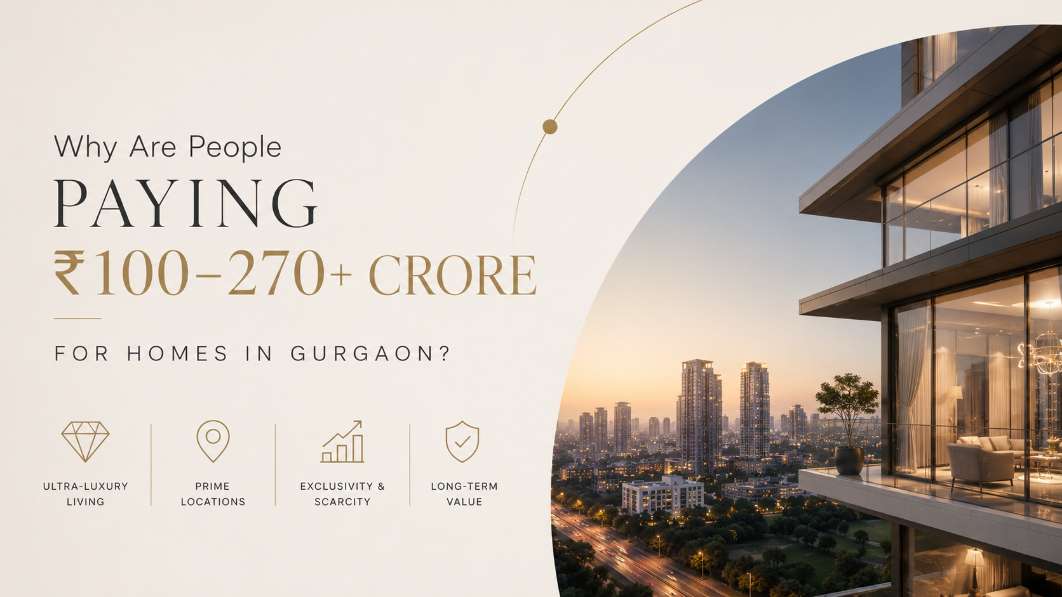
Why Are People Paying ₹100-270+ Crore for Homes in Gurgaon?
A home worth ₹100 crore once sounded almost unbelievable in Delhi-NCR. Today, it is becoming part of a very different luxury real estate conversation.
Gurugram has emerged as one of Indias strongest markets for ultra-luxury residential property, with projects such as DLF The Dahlias attracting buyers willing to spend tens, and in some cases hundreds, of crores on a single residence.
The biggest headline came in August 2026, when a penthouse at DLF The Dahlias was reported to have sold for approximately ₹271 crores. The reported 17,200 sq ft penthouse was purchased by entrepreneur Manav Sardana. The transaction put Gurugrams ultra-luxury housing market back in the national spotlight.
But the real question is not: “Who can afford a ₹271 crore home?”
The more interesting question is: Why are wealthy buyers willing to pay so much for one?
The answer has very little to do with simply buying more square feet. At the top end of the market, buyers are purchasing something much harder to manufacture: scarcity, privacy, location, identity, convenience, quality, and long-term status.
Gurgaon Has Entered a New Era of Luxury Real Estate
Gurugrams transformation has been extraordinary. What began as a corporate satellite city has become a major destination for multinational companies, entrepreneurs, senior executives, investors, business families and internationally connected Indians. The citys premium residential market has evolved alongside that wealth.
Earlier, luxury often meant:
- A large apartment
- A prestigious developer
- A clubhouse
- Good connectivity
- A premium neighbourhood
The definition is changing. For ultra-high-net-worth buyers, luxury increasingly means:
Core Formula: Very limited supply + exceptional location + privacy + large-format living + premium services + a recognisable address.
That is why the upper end of Gurgaon property prices has moved so far beyond the conventional definition of a luxury apartment.
₹271 Crore Is Not Just a Number
The reported ₹271 crore Dahlias transaction created headlines because of its size. But it signals something deeper about the market. A buyer spending ₹271 crores is not comparing the residence with an ordinary ₹10 crore or ₹20 crore apartment. The buyer is operating in a completely different category.
For this segment, the decision may involve questions such as:
- How private is the residence?
- How difficult would it be to find something comparable?
- Who else lives in the development?
- How strong is the developers reputation?
- How desirable will this address remain ten years from now?
- Can the residence function as a family estate rather than simply an apartment?
These questions show why price per square foot alone doesnot tell the whole story.
1. Scarcity Is Becoming More Valuable Than Size
The most important factor behind ultra-luxury pricing is simple economics: Very few homes are genuinely exceptional. Thousands of luxury apartments can be created across a city. Far fewer can offer:
- A prime established address
- Very large floor plates
- Low-density living
- Exceptional views
- High privacy
- Premium architecture
- Strong developer credibility
- Limited inventory
Once supply becomes extremely limited, the buyer is no longer simply purchasing accommodation. They are purchasing access to something that very few other people can own. That is the foundation of trophy real estate.
2. Privacy Has Become a Luxury Asset
Privacy is one of the biggest reasons ultra-luxury buyers move towards premium developments. A wealthy business owner or entrepreneur may already have access to luxury hotels, clubs, restaurants, private aviation and premium services. What becomes harder to obtain is personal space without sacrificing urban convenience.
That is why features such as private elevators, low-density towers, large private terraces, limited residences, dedicated arrival areas, and higher security can matter far more to an HNI buyer than another swimming pool or gym. At this level, luxury is increasingly about what you donot have to share.
3. The Location Is Doing Heavy Lifting
The most expensive residential properties in Gurugram are not randomly distributed. The premium ecosystem around Golf Course Road, DLF5 and Golf Course Extension Road has become particularly important to luxury housing.
Why? Because an address becomes more valuable when it already has a complete ecosystem around it. For wealthy families, proximity to corporate districts, premium retail, restaurants, international schools, healthcare, airports, business centers, and established luxury communities reduces everyday friction. At the ultra-luxury level, convenience itself becomes a form of wealth.
4. The Rise of the “Trophy Home”
A major psychological difference exists between buying a luxury apartment and buying a trophy home. A luxury apartment is primarily a residential purchase. A trophy residence can become part of a persons wealth identity.
It can represent achievement, family wealth, social status, legacy, and exclusivity. This is why some wealthy buyers are prepared to pay a significant premium for a residence that is difficult to replicate. The home becomes part of the owners personal portfolio of assets and experiences.
5. Gurgaon Has Produced a New Class of Luxury Buyer
Delhi-NCRs wealthy population is no longer limited to traditional industrial families. Gurugram has attracted a broader group of affluent buyers: entrepreneurs, corporate leaders, founders, investors, business families, private-equity professionals, technology executives, and NRIs.
This matters because new buyers often have a different definition of luxury. They may value design, technology, international branding, hospitality-style services, privacy, wellness, convenience, architecture, and personalisation. Luxury housing has therefore become more experience-driven.
6. The DLF Effect
DLF is an important part of this story because it has spent decades building a premium residential ecosystem in Gurugram. The companys luxury developments have helped establish certain addresses as status destinations.
The Camellias became one of the citys most recognized ultra-luxury addresses. The Dahlias represents the next stage of that evolution. The market impact is important. Once an address develops a reputation for attracting high-net-worth buyers, that reputation itself can become an asset. A luxury property is not only judged by the physical building. It is also judged by the strength of the community and address around it.
7. Why The Dahlias Is So Important
DLF The Dahlias has become one of the most closely watched luxury residential developments in Gurugram. DLF has reported strong sales bookings from the project, while several high-value transactions have brought further attention to it.
The reported ₹271 crore penthouse transaction is particularly significant because it demonstrates how far the price ceiling can move when a property combines scarcity + large format + brand + location + ultra-luxury positioning.
NOTABLE TRANSACTIONS AT DLF THE DAHLIAS
- Aug 2026: Penthouse sold for ₹271 Crore (17,200 sq ft) to entrepreneur Manav Sardana.
- Bulk Purchase: 4 apartments purchased by a Delhi-NCR industrialist for nearly ₹380 Crore.
- Investor Entry: Apartment purchased by investor Madhusudan Kela for ₹120.7 Crore.
Key Takeaway: These transactions suggest something bigger than a single expensive home: Gurgaon is developing a genuine trophy-residence market.
8. ₹100 Crore Buyers Are Not Buying for Rental Yield
This is another important distinction. For a ₹3 crore or ₹5 crore investor, rental yield and capital appreciation can play a major role. At ₹100 crores+, the decision-making framework changes.
The buyer may care more about capital preservation, scarcity, lifestyle, privacy, legacy, location, long-term prestige, and asset quality. The residence may never be purchased primarily for rental income. It can instead function as a store of wealth and lifestyle asset.
9. The Psychology of Wealth Has Changed
Indias wealth creation story has also changed. As more entrepreneurs and business families accumulate substantial wealth, spending patterns at the top of the market evolve.
For someone with a ₹1,000 crore or ₹5,000 crore net worth, spending ₹100 crores on a primary residence feels very different from someone with a net worth of ₹20 crores. The absolute price sounds enormous. But the relative allocation of wealth may still be manageable. This is one reason ultra-luxury real estate can keep finding buyers even when prices seem disconnected from the broader housing market.
Two real estate markets operate at the same time: the mass and premium housing market and the trophy asset market. The rules are different.
10. Branding Matters More at the Top End
Luxury consumers increasingly understand brands. They know that certain names carry an established perception of quality, design, service and status. This is one reason branded residences have become increasingly interesting in India.
But branding alone does not create value. A logo cannot justify a massive premium forever. The property must deliver architecture, materials, service, location, privacy, experience, and execution. The strongest luxury projects combine the brand with genuine property fundamentals.
11. The Gurgaon Luxury Market Is Becoming More International
Gurugrams buyer base increasingly includes Indians with international exposure. Many HNI and NRI buyers are already familiar with luxury residential markets in Dubai, London, Singapore, New York, and Mumbai. They therefore compare Gurgaon not only with another Gurgaon apartment; they compare it with the international concept of a luxury residence. That raises expectations around architecture, design, privacy, services, and the overall ownership experience.
12. Why ₹270 Crore Sounds Crazy to One Buyer and Sensible to Another
This is perhaps the most interesting part of the story. For most people: ₹270 crores = unimaginable wealth. For a billionaire or an ultra-high-net-worth family: ₹270 crore = one allocation within a much larger wealth portfolio.
That difference in perspective is essential to understanding ultra-luxury real estate. The market is not designed around the average buyer. It operates around a tiny pool of buyers with extraordinary purchasing power. And because the supply of trophy homes is also tiny, competition can become intense when the right property comes to market.
Is Gurgaon Creating Indias New Luxury Property Capital?
Gurugram has several advantages that make its luxury story compelling. It combines corporate wealth, entrepreneurial wealth, international connectivity, luxury housing, premium infrastructure, business districts, airport access, and established high-end communities. That combination is difficult to replicate.
Mumbai remains Indias most established luxury residential market, especially for trophy addresses. But Gurgaon has created something different: A modern luxury city built around corporate and entrepreneurial wealth. That distinction could become increasingly important over the next decade.
What This Means for Gurgaon Property Prices
The rise of ₹100 crores+ transactions does not mean every property in Gurgaon will become extraordinarily expensive. That would be a mistake. Ultra-luxury demand is highly selective. The strongest pricing power is likely to remain concentrated around properties offering:
- Exceptional locations
- Limited supply
- Large residences
- Strong developers
- High privacy
- Strong infrastructure
- Distinctive architecture
- Established luxury ecosystems
The lesson for investors is therefore not: “Buy any Gurgaon property because prices are rising.” The better lesson is: Identify the micro-markets and developments where wealthy buyers will pay a premium for scarcity.
Should You Buy a ₹100 Crore Property in Gurgaon?
There is no universal answer. Ultra-luxury property should be evaluated differently from conventional real estate. Before buying, an HNI buyer should examine:
- Developer track record
- Project approvals
- Title and documentation
- Exact carpet and saleable areas
- Maintenance costs
- Future supply
- Resale liquidity
- Neighborhood development
- Comparable transactions
- Quality of construction
- Actual scarcity
A premium brand or glamorous marketing campaign should never replace due diligence. At ₹100 crores+, even a small percentage difference in valuation represents a significant amount of money.
The Bigger Story: Luxury Is No Longer About “More”
Perhaps the biggest lesson from Gurgaons ultra-luxury market is that wealthy buyers are not necessarily searching for the biggest possible house. They are searching for the right house: the right address, the right community, the right privacy, the right view, the right design, the right developer, and the right level of scarcity.
That is why a residence can be worth ₹100 crores to one buyer and completely irrelevant to another. At the top of the market, luxury is not about affordability alone. It is about access.
- Access to a particular address
- Access to a particular lifestyle
- Access to privacy
- Access to an asset that very few people can own
That is ultimately why ₹100 crores, ₹200 crores, and even ₹270+ crore homes are finding buyers in Gurgaon. The price is extraordinary. But so is the market being created around it.
Final Takeaway: The rise of ₹100 crores, ₹200 crores, and ₹270+ crore homes in Gurgaon is not simply a story about expensive apartments. It is a story about Indias changing wealth landscape. As more entrepreneurs, business families and high-net-worth individuals create substantial wealth, the definition of luxury housing is moving upward. The winning properties will not necessarily be the ones with the most amenities. They will be the ones that offer something much harder to create: Scarcity. Privacy. Identity. Location. Legacy. Thats why Gurgaons most expensive homes are no longer judged by the average homebuyer. The worlds wealthiest buyers judge them by a very different definition of value.
Frequently Asked Questions
1. Why are homes in Gurgaon selling for ₹100 crore or more?
Homes above ₹100 crores in Gurgaon are generally ultra-luxury or trophy residences with exceptional location, large floor areas, privacy, limited inventory and premium amenities. Demand comes mainly from HNIs, entrepreneurs, business families and investors seeking scarce residential assets in established luxury micro-markets.
2. What is the most expensive home sold in Gurgaon?
One of the biggest recent reported transactions is a penthouse at DLF The Dahlias in Gurugram, reported at approximately ₹271 crores in August 2026. The reported transaction involved a 17,200 sq ft penthouse, highlighting the extraordinary pricing achieved at the top end of Gurgaons luxury residential market.
3. Why is DLF The Dahlias so expensive?
DLF The Dahlias combines a prestigious DLF brand, a prime Gurugram location, large-format residences, limited inventory, and ultra-luxury positioning. Strong demand for trophy homes in established luxury corridors also supports its pricing. Individual unit prices vary depending on size, floor, configuration, views and other property-specific factors.
4. Is Gurgaon Indias most expensive residential market?
Gurgaon is one of Indias strongest ultra-luxury residential markets and has produced several extremely high-value transactions. Mumbai remains a major competing luxury market, particularly for trophy addresses. Gurgaon is distinctive because entrepreneurs, corporate leaders, business families, and HNI buyers strongly support its luxury demand.
5. Who buys ₹100 crore homes in Gurgaon?
Ultra-high-net-worth individuals, entrepreneurs, business families, investors, and senior corporate or professional leaders generally buy 100 crore homes. Some buyers may also include NRIs or families seeking a permanent luxury residence in Delhi-NCR. These buyers typically evaluate privacy, scarcity, location and long-term value alongside the property itself.
6. Are ₹100 crore Gurgaon properties a good investment?
A ₹100 crore property can be a strong wealth-preservation asset for the right buyer, but it is not automatically a good investment. Ultra-luxury properties can have limited resale and rental liquidity. Buyers should assess entry price, location, scarcity, developer quality, competing supply, transaction history and long-term demand.
7. Why are luxury property prices rising in Gurgaon?
Strong wealth creation, corporate expansion, premiumisation, limited supply in select micro-markets, and rising demand from HNI and NRI buyers are supporting luxury property prices in Gurgaon. Prime locations such as Golf Course Road and surrounding luxury corridors have benefited particularly from this shift toward larger and more exclusive residences.
8. Is DLF The Dahlias better than DLF The Camellias?
The Dahlias and The Camellias represent different stages of Gurgaons ultra-luxury market. The Camellias has an established reputation and resale ecosystem, while The Dahlias represents a newer generation of super-luxury residences. The better option depends on the buyers priorities, including inventory, views, layout, pricing, privacy, investment horizon, and preferred location.
9. Why are rich people buying apartments instead of independent houses?
Ultra-luxury apartments can offer a combination that independent homes may not easily replicate: security, professional maintenance, premium amenities, managed infrastructure, privacy, views and a prestigious community. For wealthy buyers, a well-designed luxury apartment can provide a more convenient lifestyle than managing a large independent property.
10. Will Gurgaon continue producing ₹100 crores+ homes?
Gurgaon has the underlying wealth, luxury demand and development ecosystem required to support more ultra-high-value residences. However, ₹100 crores+ pricing will remain concentrated in exceptional properties rather than becoming normal across the market. Future transactions will depend on scarcity, location, developer reputation, buyer wealth and overall economic conditions.