Home Loan for Luxury Property in India 2026: Banks, Eligibility and NRI Process
Most home loan content in India targets the Rs 50 lakh to Rs 1 crore bracket. Buyers at the Rs 5 crore to Rs 15 crore level face a different set of rules: higher down payments, stricter documentation, longer processing times and fewer banks willing to lend at these ticket sizes. For luxury property in Gurgaon (DLF Privana at Rs 6.90 to Rs 9.35 crore, DLF Aureva at Rs 11.76 crore, DLF Dahlias at Rs 100 crore+), you need to plan the financing structure well before booking. This guide covers which banks lend for luxury property, LTV ratios at high ticket sizes, NRI-specific eligibility and the documentation process for loans above Rs 5 crore.
RBI LTV Rules for High-Value Properties
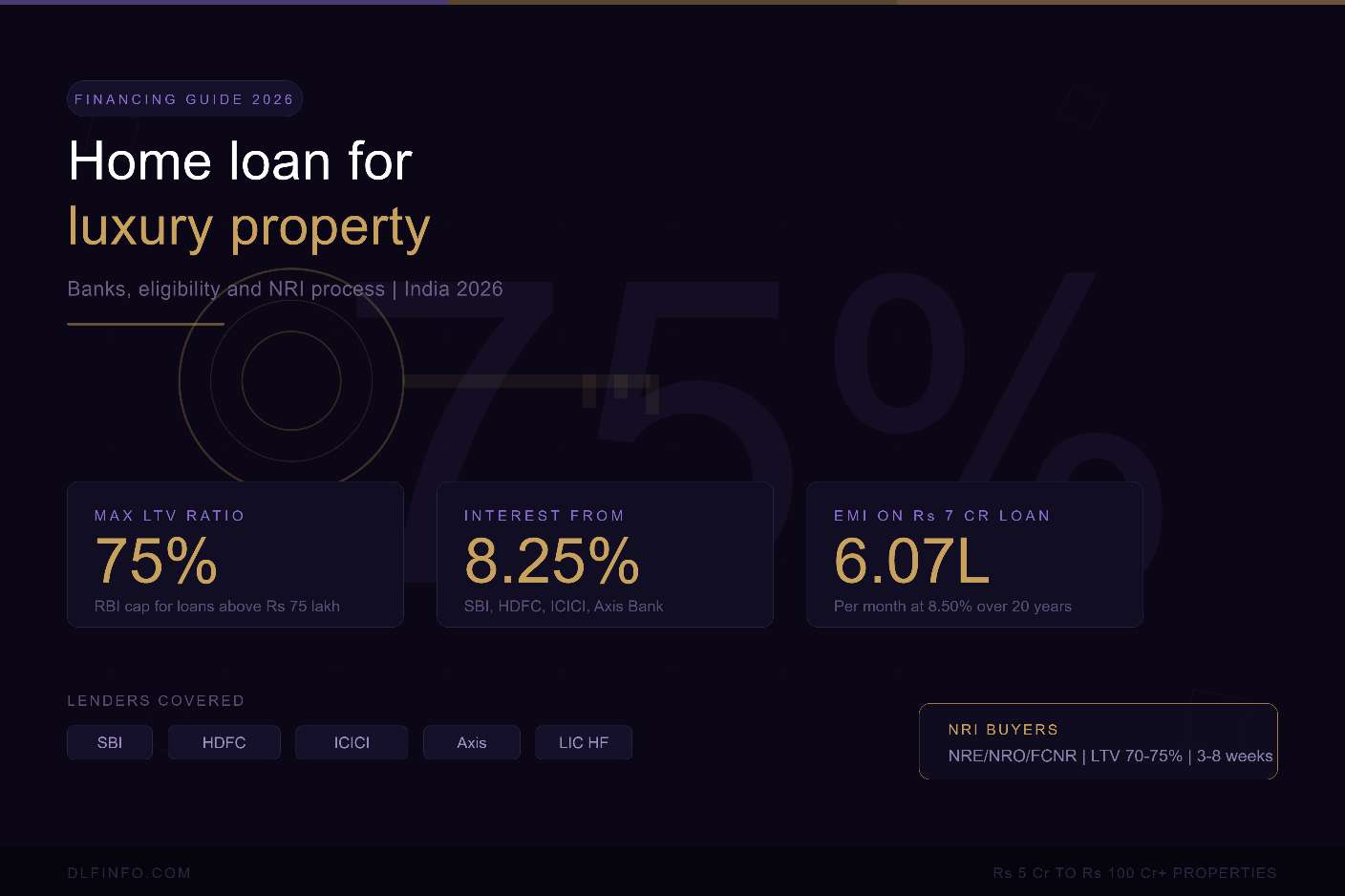
The Reserve Bank of India mandates Loan-to-Value (LTV) limits based on loan amount. For loans up to Rs 30 lakh, LTV can be up to 90%. For Rs 30 to Rs 75 lakh, LTV drops to 80%. For loans above Rs 75 lakh, LTV is capped at 75%. This means for a Rs 9.35 crore property (DLF Privana North), the maximum loan is approximately Rs 7 crore, and you need Rs 2.35 crore as a down payment from your own funds. For a Rs 6.90 crore property (Privana South), the maximum loan is approximately Rs 5.17 crore, requiring Rs 1.73 crore upfront.
In practice, some banks apply even stricter LTV limits for ultra-high-value properties. Loans above Rs 5 crore often get an LTV of 65 to 70% rather than the regulatory maximum of 75%. This is a credit risk decision by the bank, not an RBI rule. Always confirm the specific LTV with your relationship manager before budgeting.
Which Banks Lend for Luxury Property (Rs 5 Crore and Above)
- State Bank of India (SBI): Offers home loans with no upper limit for salaried applicants. Interest rates start at 8.25% (repo-linked). SBI has the largest NRI home loan book in India. Processing time: 3 to 6 weeks for high-value loans.
- HDFC Ltd (now merged with HDFC Bank): One of the most active lenders for luxury property in Gurgaon. Offers loans above Rs 10 crore for qualified borrowers. Interest rates from 8.70% onwards. Strong NRI desk with presence in the US, UAE, Singapore, and the UK.
- ICICI Bank: Offers home loans up to Rs 15 crore for salaried HNIs with strong credit profiles. Interest rates from 8.50% onwards. Digital processing for NRIs. Can work with DLFs in-house finance team to coordinate documents.
- Axis Bank: Offers luxury home loans with tailored structures for HNIs. Interest rates from 8.75% onwards. Good for self-employed borrowers with complex income structures.
- LIC Housing Finance: Offers high-value loans with slightly longer processing time but competitive rates (from 8.40% onwards). Popular with government employees and professionals.
NRI Home Loan Eligibility
NRIs and OCIs can take home loans from Indian banks under FEMA regulations. The key differences from resident loans: interest rates are typically 0.25 to 0.50% higher, LTV is often capped at 70 to 75% (some banks restrict to 60% for NRIs), EMI must be paid from NRE or NRO accounts, a co-applicant in India may be required by some lenders, and documentation includes overseas employment proof, visa, passport, and foreign bank statements.
NRI home loan processing takes 3 to 8 weeks. Start the pre-approval process before finalizing the property, not after. A pre-approval letter gives you negotiating strength and confirms your budget ceiling.
EMI Reality Check at Luxury Price Points
For a Rs 7 crore loan at 8.50% over 20 years, the monthly EMI is approximately Rs 6.07 lakh. For a Rs 5 crore loan at the same terms, the EMI is approximately Rs 4.34 lakh. Your bank will typically require that the EMI does not exceed 50 to 55% of your monthly income (including all existing loan obligations). So to qualify for a Rs 7 crore loan, your household income needs to be approximately Rs 11 to Rs 12 lakh per month (Rs 1.32 to Rs 1.44 crore per year).
Many luxury buyers use a mix of own funds (60 to 70%) and a loan (30 to 40%) rather than maximizing the LTV. This reduces interest outflow and speeds up approval. For NRIs with income in USD, GBP or AED, the exchange rate works in favour of building a larger own-funds contribution.
Tax Benefits on Home Loan for Luxury Property
Under the old income tax regime (which must be actively opted into for FY 2025-26), Section 24(b) allows interest deduction of up to Rs 2 lakh per year for a self-occupied property. Section 80C allows principal repayment deduction of up to Rs 1.50 lakh per year. For a luxury property with a Rs 7 crore loan, the annual interest alone is approximately Rs 59 lakh, so the Rs 2 lakh cap means the tax benefit covers only a small fraction of the actual interest paid.
Under the new tax regime (default since FY 2023-24), home loan deductions are not available for self-occupied property. They are available for let-out property up to the actual interest paid. Many HNIs keep the property on rent (even to family members at fair market value) to claim deductions under the new regime. Consult your CA for the structure that minimizes your total tax outflow.
Conclusion
- RBI caps LTV at 75% for loans above Rs 75 lakh. For a Rs 9.35 crore property, you need approximately Rs 2.35 crore as a down payment.
- SBI, HDFC, ICICI, and Axis are the most active lenders for luxury properties above Rs 5 crore. Interest rates start at 8.25%.
- NRIs can take home loans under FEMA with slightly higher rates and LTV restrictions. Start pre-approval before property selection.
- Tax benefits under Section 24(b) are capped at Rs 2 lakh, which covers a small fraction of interest on luxury loans. Structure the ownership with your CA.
For a financing consultation on any DLF property, connect with the DLFInfo advisory desk.
Frequently Asked Questions
Q: Can I get a home loan for a Rs 10 crore property in India?
A: Yes. SBI, HDFC Bank, ICICI Bank and Axis Bank offer home loans above Rs 10 crore for qualified borrowers. The RBI-mandated LTV cap is 75% for loans above Rs 75 lakh, so you will need approximately Rs 2.50 crore as a down payment for a Rs 10 crore property. Actual LTV from the bank may be 65 to 70% for ultra-high-value loans.
Q: What income do I need for a Rs 7 crore home loan?
A: At 8.50% over 20 years, the EMI is approximately Rs 6.07 lakh per month. Banks require the EMI to be within 50 to 55% of monthly income. So your household income should be Rs 11 to Rs 12 lakh per month (Rs 1.32 to Rs 1.44 crore per year). Banks deduct existing loan EMIs from the eligible income.
Q: Can NRIs get home loans for DLF properties?
A: Yes. NRIs and OCIs can take home loans from Indian banks under FEMA regulations. Rates are 0.25 to 0.50% higher than resident rates. LTV is typically 70 to 75%. You must pay the EMI from NRE or NRO accounts. Processing takes 3 to 8 weeks. SBI and HDFC have the largest NRI home loan desks.
Q: Do home loan tax benefits work for luxury property?
A: Under the old tax regime, Section 24(b) deduction is capped at Rs 2 lakh per year for self-occupied property, regardless of the loan size. For a Rs 7 crore loan, annual interest is about Rs 59 lakh, so the benefit covers only a small fraction. Under the new regime, you cannot claim any deduction for self-occupied property. Consult a CA for the most tax-efficient structure.