Nepal Flash Flood 2026: Causes, Death Toll, Missing People & Latest Updates
Last updated: 27 August 2026, 12:30 PM IST. This is a developing story.
Nepal Police, the National Disaster Risk Reduction and Management Authority, and the Nepal Tourism Board revise official death and missing figures several times a day. The numbers below reflect the latest confirmed statements available at the time of writing.
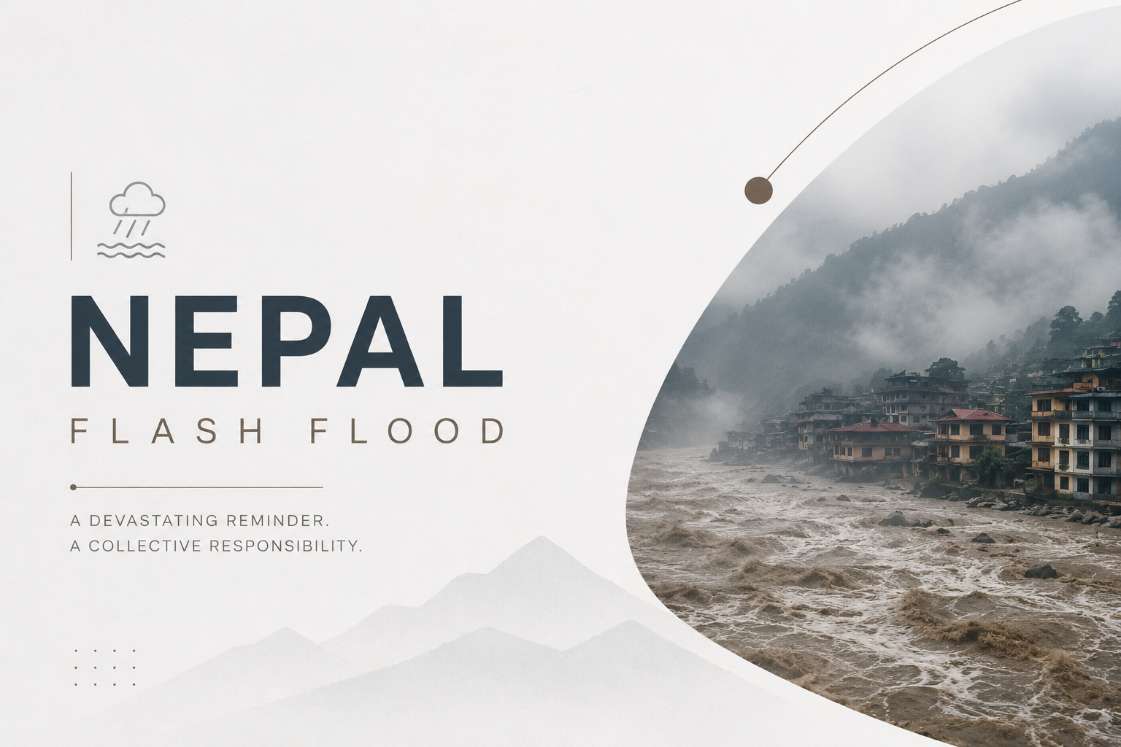
On the morning of Wednesday, 26 August 2026, a wall of water, ice, mud and boulders came down the Bhote Koshi river in Nepal’s Rasuwa district, close to the border with Tibet. No heavy rain had fallen that morning. There was no warning. Within minutes, the border town of Timure was gone, the Rasuwagadhi crossing into China was cut off, and the surge raced down the Trishuli valley toward Nuwakot.
It has become one of the deadliest single-day disasters Nepal has seen in years, and one of the most unusual. Most of Nepal’s flood deaths happen during monsoon downpours. This one came out of a clear sky, from a glacier roughly 20 to 50 kilometers upstream, in a valley that had already flooded the same way just thirteen months earlier.
This page pulls together what is actually known so far: what caused the flood, how many people have died, how many are still missing, which areas were hit, what rescue teams are doing, and what families of missing travellers can do right now.
Nepal Flash Flood 2026: Key Facts at a Glance
- Date and time: Wednesday, 26 August 2026, at roughly 8:30 to 9:00 AM Nepal time.
- Location: Bhote Koshi River, Rasuwa District, northern Nepal, near the Rasuwagadhi–Gyirong border crossing with Tibet. Damage carried downstream into Nuwakot district along the Trishuli River.
- Suspected cause: An ice and rock avalanche off a glacier fell into the Lhende Khola, a small tributary, and dammed it. The natural dam gave way and released the water in one surge. A glacial lake outburst upstream in Tibet may also have contributed. This is a preliminary assessment, not a final finding.
- Confirmed dead in Nepal: At least 175 as of 27 August, with police having recovered more than 157 bodies. Officials expect the number to rise.
- Confirmed dead in Tibet: Three, according to Chinese state media, with rescue operations continuing at Gyirong.
- Missing: Nepali authorities initially listed 403 people unaccounted for, of whom 341 were foreign nationals. Later counts put the number of missing foreigners at close to 500, from 28 countries. Chinese state broadcaster CCTV reported 558 people missing on the Tibet side, including 260 foreigners. Combined figures reported by international media have exceeded 1,300, though it is unclear whether the two countries are counting some of the same people.
- Power infrastructure hit: Around 11 hydropower projects, roughly 405 to 430 MW of generation capacity, close to one-eighth of Nepal’s installed capacity.
- Border trade: The Rasuwagadhi crossing, Nepal’s main trade gateway to China, is out of action weeks before the Dashain festival buying season.
What Happened on 26 August 2026
The flood reached Timure at around 8:30 in the morning. Timure sits on the Bhote Koshi just short of the Nepal–China border, and it is the last Nepali town most travellers pass through on their way to the Rasuwagadhi crossing. On a normal August morning it is full of trucks waiting to clear customs, tour buses carrying pilgrims towards Kailash, guest houses, guides and porters.
Videos taken by residents show what came through: not clear river water but a moving mass of grey slurry carrying boulders, tree trunks and pieces of buildings. The Rasuwa Chief District Officer said there had been no rainfall at the district headquarters that morning, which told officials straight away that whatever caused this had happened somewhere far upstream.
The surge did not stop at Timure. It carried on down the Bhote Koshi, which becomes the Trishuli river, and hit settlements in Nuwakot district including Betrawati, Trishuli Bazar, Dhunge and Devighat. At Galchhi, further downstream, river levels reportedly rose by as much as nine meters in half an hour. That is roughly the height of a three-storey building, arriving in the time it takes to have a cup of tea.
Emergency alerts went out along the Trishuli basin as far as Mugling and Narayanghat, telling people living close to the river to move to higher ground. In Rasuwa itself, the helipad rescue teams needed were swept away, making the first hours of the response especially difficult.
Which Areas Were Worst Affected
Rasuwa district
Timure, Rasuwagadhi and Syafrubesi took the direct hit. Timure has essentially been erased in places. Satellite images taken on 26 August show the town buried under debris where buildings stood a day earlier. The Pasang Lhamu Highway, which connects this corridor to Kathmandu, was cut in several sections, stranding hundreds of travellers’ and freight trucks.
Nuwakot district
Further down the Trishuli, the flood behaved less like a wall and more like a rising tide, but it still submerged homes and commercial areas in muddy water at Betrawati, Trishuli Bazar, Dhunge and Devighat. Photographs from Devighat show houses half-buried in sludge and residents digging out what they could.
Gyirong county, Tibet
On the Chinese side of the border, a mudslide hit the Gyirong Port land crossing. Chinese state media reported three dead and a large number of people missing, and described major casualties. Chinese President Xi Jinping ordered authorities to step up search efforts. Gyirong is a busy crossing point, so the missing there include a mix of Chinese nationals, Nepali workers and foreign travelers.
What Caused the Nepal Flash Flood 2026?
This is the question everyone is asking, and the honest answer is that scientists have a strong preliminary explanation but not a confirmed one yet. Here is what the evidence points to.
1. An ice avalanche blocked a small river, then the block burst
The leading assessment, put forward by glaciologists at Kathmandu University and supported by early work from the International Centre for Integrated Mountain Development, is that an ice and rock avalanche came off a glacier and dropped into the Lhende Khola. The Lhende is a small tributary that feeds the Bhote Koshi near the border.
When that mass of ice and rock landed in the river, it formed a natural dam. Water built up behind it, possibly for hours, possibly for longer. Then the dam failed, all at once, and everything that had been stored behind it went downstream in a single pulse. That is why the flood arrived as a wall rather than a gradual rise, and why it carried so much rock and sediment.
Nepal’s National Disaster Risk Reduction and Management Authority described it as a glacier-related flood originating from a landslide about 20 kilometres northeast of the border crossing.
2. A glacial lake outburst may have been involved too
Several experts think a glacial lake outburst flood, commonly shortened to GLOF, may have happened alongside or instead of the avalanche blockage. Researchers have pointed to a cluster of glacial lakes roughly 40 to 50 kilometres upstream inside Tibetan territory, some of which have been growing and merging in recent years.
A GLOF happens when a lake that has formed on, inside or in front of a glacier suddenly drains. The barrier holding it back is often just loose moraine debris or ice, not solid rock, so it can fail without much warning. Satellite analysis over the coming days should settle whether one of these lakes shrank on 26 August, which is how the 2025 event in the same valley was eventually confirmed.
3. A small earthquake, and why it matters
The US Geological Survey recorded a magnitude 4.4 earthquake early on Wednesday, roughly 100 kilometres north of Kathmandu near the Tibet border. A 4.4 is a modest quake and would not normally cause a disaster like this. But on unstable, steep, ice-loaded slopes it does not take much shaking to dislodge a mass that was already close to letting go. Investigators are looking at whether the tremor was the final trigger.
4. The thing that was not the cause: rain
It is worth repeating because it goes against what most people assume about Nepal in August. Rasuwa had no heavy rainfall that morning. Monsoon flooding is a familiar annual problem in Nepal and the country plans for it. This was a different kind of event, generated in the high mountains, arriving in a valley where the sky was clear.
5. The bigger reason: warming mountains
This same valley flooded on 8 July 2025. Nepal’s Department of Hydrology and Meteorology traced that flood to a supraglacial lake about 36 kilometers north of the border at an altitude of around 5,150 meters. Satellite images showed the lake shrank from about 0.74 square kilometers to about 0.60 square kilometers, proving it had released a large volume of water. That flood washed away the Miteri bridge linking Nepal and China.
So this is the second major glacier-driven flood down the Bhote Koshi in just over a year. ICIMOD has identified 47 glacial lakes that are considered potentially dangerous to Nepal. Researchers say small lakes in the Tibetan region near Rasuwa have been merging into larger ones. As temperatures rise, glaciers retreat, meltwater pools where ice used to sit, and the debris barriers holding those pools back become less reliable. The Hindu Kush Himalaya region is warming faster than the global average, and events once described as once-in-a-generation are now happening in consecutive summers.
Nepal Flash Flood 2026 Death Toll
The confirmed death toll has climbed steeply since the first reports. In the hours immediately after the flood, officials were reporting single-digit and then double-digit numbers as bodies were recovered downstream. By Wednesday night, Nepal Police said 157 bodies had been recovered. By the morning of 27 August, the toll being reported stood at least 175 in Nepal.
Three deaths have been confirmed on the Tibetan side by Chinese authorities, with rescue operations still underway there.
Nepal Police have not released nationality breakdowns of the recovered bodies. Officials have said openly that they expect the toll to keep rising, because a very large number of people remain unaccounted for and because bodies from an event like this are carried far downstream and recovered over days.
If you are reading this sometime after 27 August 2026, treat the figures above as a snapshot. Check Nepal Police and the Ministry of Home Affairs for the current official count.
How Many People Are Missing?
The missing count is the most alarming part of this disaster, and also the most confusing, because Nepal and China keep separate lists that may overlap.
On the Nepal side
The Nepal Tourism Board initially listed 403 people as unaccounted for, of whom 341 were foreign nationals and the rest Nepali citizens. As embassies checked in and tour operators reported losing contact with their groups, the count of missing foreigners rose, with later figures putting it close to 500 people from 28 countries.
Country-wise figures released through Nepal’s embassy in India have included roughly 177 people from India, 63 from the United States, 53 from Ukraine, 34 from Australia, 33 from the United Kingdom, 28 from Malaysia and 25 from Canada, with smaller numbers from many other countries. Earlier lists released by the Tourism Board gave lower counts for several of these nationalities, so expect these figures to keep shifting as people are located and duplicate entries are removed.
Also missing are nine Armed Police Force personnel who were stationed at the Timure border outpost, and South Korean workers who were building a hydropower plant in the area.
On the Tibet side
Chinese state broadcaster CCTV reported that at least 558 people were believed missing at the Gyirong crossing, of whom 260 were foreign nationals.
Why so many foreigners were in one place
Two things came together on the same morning:
- The Kailash Mansarovar Yatra: August is peak season for the pilgrimage to Mount Kailash in Tibet, a site sacred to Hindus, Buddhists, Jains and followers of Bon. The overland route runs through Nepal’s Rasuwa district and crosses at Rasuwagadhi into Gyirong. Hundreds of Indian pilgrims and international trekkers were moving along that corridor.
- Janai Purnima: The flood coincided with the Nepali festival of Janai Purnima, when large numbers of Nepali pilgrims trek to the sacred Gosaikunda lakes in Rasuwa. At least 62 of the missing Nepali citizens are believed to have been among those trekkers.
One Kathmandu-based operator reported 26 foreign tourists and five Nepali guides missing from a single group. Another operator reported 47 people missing from one tour group, including children as young as 12. These are not abstract numbers. They are buses and guest houses full of people who were in exactly the wrong place at 8:30 in the morning.
Rescue Operations and Government Response
The Nepal Army, Nepal Police and Armed Police Force were mobilized immediately, with helicopters brought in because the roads were gone. The loss of the helipad at Rasuwa made the first day’s operations far harder than they should have been, and teams had to work around damaged and blocked sections of the Pasang Lhamu Highway.
Nepal has formally asked India and China for search-and-rescue assistance. A government spokesperson publicly confirmed the request. The Prime Minister has called for national unity in the response, and the Finance Minister has been coordinating with the Timure Customs Office on the ground.
On the Chinese side, large-scale search and rescue is underway in Gyirong, with President Xi Jinping having ordered authorities to intensify efforts. India’s Prime Minister has also issued a statement on the disaster, given the large number of Indian pilgrims affected.
Search teams face a hard problem. The debris field is deep, unstable and spread over many kilometres of valley. Bodies and survivors could be anywhere along a river system that runs far downstream. And the same glacial instability that caused the flood has not gone away, so teams working upstream have to keep one eye on the mountain.
Damage to Power, Roads and Trade
Hydropower
This is where the economic damage really bites. Nepal has built a large share of its generating capacity along exactly these steep, fast-flowing rivers. The Nepal Electricity Authority reported damage to six major hydropower and transmission facilities, while the Independent Energy Producers’ Association put the number of affected projects at more than ten. Among them are the 111 MW Rasuwagadhi project, Chilime, Trishuli 3A, the Trishuli 3B Hub 220 kV substation, Trishuli Hydropower Station, and Devighat Hydropower Station.
The combined affected capacity is between 405 and 430 MW, close to one-eighth of Nepal’s installed capacity. Some of these plants will be back within weeks. Others, where powerhouses and dams took direct hits, will take far longer and cost a great deal.
Roads and the border
The Rasuwagadhi crossing is Nepal’s most important land trade route to China. With the crossing disrupted and the highway to it broken in multiple places, imports moving through that corridor have stopped. The timing is bad. Dashain, Nepal’s biggest festival and its biggest retail season, is approaching, and many festival goods come through this route.
Homes and livelihoods
Assessments are still going on across Rasuwa and Nuwakot. Whole settlements in the upper valley have been destroyed rather than damaged. Downstream, the pattern is more mixed, with homes and shops flooded and buried in sediment. Guest houses, trekking businesses, transport operators and border traders in this corridor have lost both their premises and their season.
If You Have a Family Member Missing: What to Do Now
- Contact your country’s embassy or high commission in Kathmandu directly. Embassies are maintaining lists of nationals in the affected area and are the fastest route to official information.
- Contact the tour operator or trekking agency the person travelled with. Several operators are publishing group-by-group updates and have been the first to confirm which of their clients are safe.
- Register the person with the Nepal Tourism Board and Nepal Police. The official missing list is compiled from these reports, and authorities will not actively search for someone not on the list.
- Keep phones charged and lines open. Communication in the region is patchy and survivors have been reaching relatives at odd hours from borrowed phones.
- Be careful with social media claims. Unverified lists of the dead and missing are circulating. Do not treat any name as confirmed unless it comes from police, an embassy or the tour operator.
If You Are Travelling to Nepal in the Next Few Weeks
- The Rasuwagadhi corridor, including Timure, Syafrubesi and the Gosaikunda trekking route, should be considered closed. Do not attempt it.
- Kailash Mansarovar Yatra travel through the Rasuwagadhi–Gyirong route is disrupted indefinitely. Speak to your operator about alternative routes or refunds.
- Check the status of the Pasang Lhamu Highway before travelling anywhere north of Kathmandu.
- Follow official advisories from Nepal’s Department of Hydrology and Meteorology, which issues river-level warnings for the Trishuli basin.
- Trekking elsewhere in Nepal is largely unaffected, but monsoon season carries landslide risk on many routes, so take local advice seriously.
Why This Keeps Happening, and What Could Reduce the Risk
Nepal is downstream of a mountain range that is changing quickly. The country cannot control what happens on a glacier 40 kilometres inside Tibetan territory, which is the uncomfortable heart of this problem. The 2025 flood came from Chinese territory. This one appears to have as well.
What can be done in three areas?
- Monitoring: Satellite tracking of high-altitude lakes already exists, but it is used mostly to explain floods after they happen rather than to warn before. Continuous automated monitoring of the specific lakes ICIMOD has flagged as dangerous, shared across the Nepal–China border, would change that.
- Early warning: Even twenty minutes of warning would have emptied Timure. Sensors placed on upstream tributaries like the Lhende, wired to sirens and mobile alerts in downstream settlements, are proven technology and not especially expensive compared with what a single hydropower plant costs.
- Where things get built: Hydropower projects, customs yards, guest houses and highways in this corridor sit directly in the path of the river, because there is nowhere else flat to put them. That will not change overnight, but the design assumptions can. Structures built for monsoon flooding are not built for a glacial surge carrying boulders.
Cross-border cooperation is what makes all three work. A warning system that stops at a national border is not a warning system.
Final Thoughts
Nepal has faced worse monsoon seasons in terms of total deaths. The 2024 floods killed more than 230 people over several days across many districts. What makes 26 August 2026 different is how it happened: no rain, no warning, one valley, a few minutes.
The search continues, and the numbers in this article will change. Hundreds of families in India, Nepal, the United States, Ukraine, Australia, the United Kingdom, Malaysia, Canada and elsewhere are waiting for a phone call. The rest of the story, about warning systems, cross-border monitoring and where infrastructure gets built in glacier-fed valleys, is one Nepal has now been handed twice in thirteen months.
Frequently Asked Questions (FAQ)
- What caused the Nepal flash flood in August 2026?
- The leading preliminary assessment is that an ice and rock avalanche fell from a glacier into the Lhende Khola, a tributary of the Bhote Koshi river, and dammed it. When the natural dam burst, it released all the stored water at once. A glacial lake outburst upstream in Tibet may also have contributed. There was no heavy rainfall in the area that morning. A magnitude 4.4 earthquake recorded early that day is being examined as a possible trigger. Scientists have not yet confirmed the official cause.
- How many people died in the Nepal flood 2026?
- As of 27 August 2026, at least 175 deaths had been confirmed in Nepal, with police having recovered more than 157 bodies. Three deaths have been confirmed in Tibet. Officials expect the toll to rise as search operations continue.
- How many people are missing after the Nepal flood?
- Nepali authorities initially listed 403 people as missing, including 341 foreign nationals. Later counts put the number of missing foreigners at close to 500 from 28 countries. Chinese state media reported 558 people missing on the Tibet side, including 260 foreigners. Combined totals reported in international media have exceeded 1,300, but Nepal and China may be counting some of the same people.
- Which areas of Nepal were affected by the 2026 flash flood?
- The worst damage was in Rasuwa district, particularly Timure, Rasuwagadhi and Syafrubesi near the Nepal–China border. Downstream, Nuwakot district was hit along the Trishuli River, including Betrawati, Trishuli Bazar, Dhunge and Devighat. Alerts were issued as far downstream as Mugling and Narayanghat.
- Were Kailash Mansarovar Yatra pilgrims affected?
- Yes. August is peak season for the Kailash Mansarovar Yatra, and the overland route passes through Rasuwa and crosses into Tibet at Rasuwagadhi. A large number of the missing are pilgrims and trekkers who were moving along this corridor, including a significant number of Indian nationals.
- What is a glacial lake outburst flood (GLOF)?
- A GLOF happens when a lake formed on, inside, or in front of a glacier suddenly drains. These lakes are usually held back by loose moraine debris or ice rather than solid rock, so the barrier can fail with little or no warning. The released water travels downstream as a fast, destructive surge carrying rock and sediment. ICIMOD has identified 47 glacial lakes considered potentially dangerous to Nepal.
- Did this happen in the same place before?
- Yes. On 8 July 2025, a flash flood struck the same Bhote Koshi corridor. Nepal’s Department of Hydrology and Meteorology concluded it was caused by a supraglacial lake outburst about 36 kilometres north of the border at around 5,150 metres altitude. Satellite images showed the lake had shrunk noticeably, confirming a large water release. That flood washed away the Miteri bridge connecting Nepal and China.
- How much damage was done to Nepal’s power supply?
- Around 11 hydropower projects were affected, with roughly 405 to 430 MW of capacity disrupted, close to one-eighth of Nepal’s installed capacity. Damaged facilities include the 111 MW Rasuwagadhi project, Chilime, Trishuli 3A, the Trishuli 3B Hub 220 kV substation, Trishuli Hydropower Station and Devighat Hydropower Station.
- Is the Nepal–China border crossing open?
- No. The Rasuwagadhi crossing, Nepal’s main land trade route with China, has been disrupted, and the Pasang Lhamu Highway leading to it is damaged in several sections. With Dashain approaching, this is expected to affect the supply of imported goods.
- Is it safe to travel to Nepal right now?
- The Rasuwa corridor, including Timure, Syafrubesi and the Gosaikunda trekking route, should be treated as closed. Most other parts of Nepal are not directly affected by this flood, but monsoon season brings landslide and flooding risk on many routes. Check current advisories and take local guidance before travelling anywhere in the hills.
- Was climate change responsible for this flood?
- No single event can be attributed to climate change with certainty without a formal study. Researchers say the Hindu Kush Himalaya region is warming faster than the global average, glaciers are retreating, and meltwater lakes are growing and merging where ice used to be. Those conditions increase the frequency of glacier-related floods. Two major events in the same valley within thirteen months fit that pattern.
- Where can I get official updates?
- Nepal Police, the Ministry of Home Affairs, the National Disaster Risk Reduction and Management Authority and the Nepal Tourism Board are the primary official sources. For missing foreign nationals, the relevant embassy in Kathmandu is the fastest route to information. Avoid relying on unverified lists circulating on social media.